How AV rental companies can add spoken translation to live events
Speech-to-Speech is now available. Book a demo to try spoken translation and discuss your event setup.
International events often create a simple challenge: not everyone in the room follows the spoken language equally well.
Live captions and translated text give attendees another way to follow what is being said. Speech-to-Speech lets AV rental companies add one more option to the production: spoken translation.
Instead of only reading the translation, attendees can choose to listen to it on their own device.
For AV companies, that creates an additional service that can be offered within professional event productions without changing the core role of the AV partner.
Want to see how it works in an event setup? Book a demo.
What is Speech-to-Speech for live events?
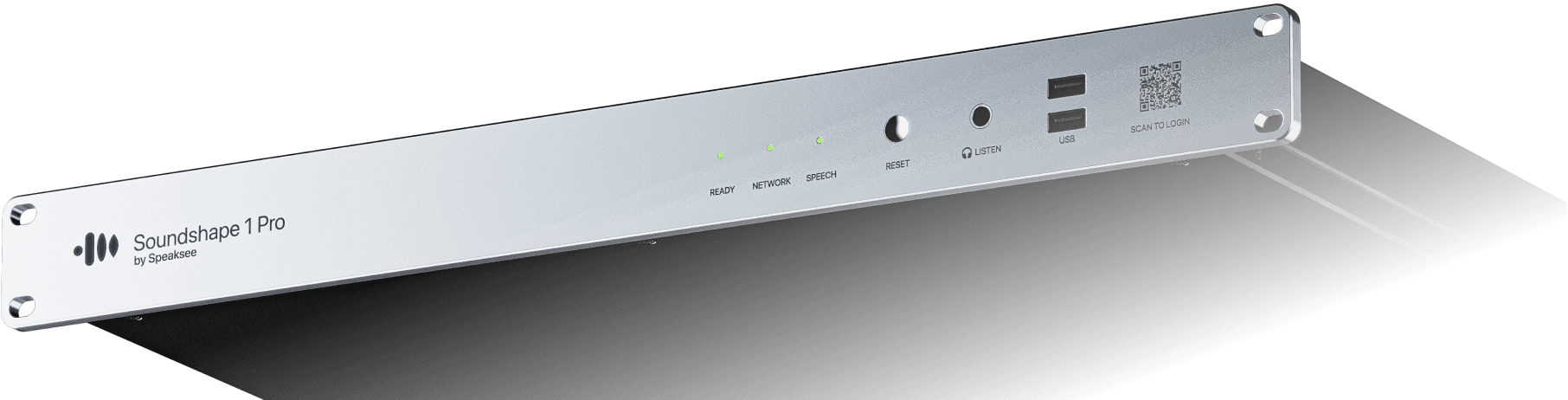
Speech-to-Speech adds spoken translation to the Soundshape experience.
During a live event, attendees can choose how they want to follow the content:
live captions;
translated text;
spoken translation.
The attendee uses their own device and selects the language they want to follow.
If they prefer listening, the translated audio can continue playing when the phone is locked. That can be especially useful during longer presentations or congress sessions where continuously looking at a screen is less practical.

When does spoken translation become relevant for an AV production?
It becomes interesting as soon as an organiser expects an audience that does not all speak the same language.
For example, imagine an international business conference with presentations in English and visitors from several European countries.
Some attendees may be comfortable following the presentation in English. Others may prefer translated captions. Another group may rather listen to the translation while keeping their attention on the speaker and presentation slides.
The AV partner does not have to choose one format for the entire audience.
Soundshape gives attendees the choice to read or listen.
How can AV rental companies offer Speech-to-Speech?
The easiest moment to introduce spoken translation is during the normal preparation of an event.
Use W3C’s accessible events checklist to support the wider accessibility discussion with your client.
When discussing the production with a client, ask questions such as:
Will there be international attendees?
Is the event held in one main language?
Are there longer presentations or panel sessions?
How are visitors who do not speak the main language supported today?
Would attendees benefit from being able to listen to a translation?
If the answer points to a multilingual audience, Speech-to-Speech becomes another option the AV company can propose.
It is not a separate conversation about accessibility technology. It can simply become part of the normal discussion about how the audience will experience the event.
Have a client event where this could fit? See Speech-to-Speech in a demo.
What does this add to an AV rental offering?
For AV rental companies, the value is mainly in expanding what can be offered to the customer.
A production can already include audio, video, lighting and presentation technology. Soundshape adds a language layer to that setup.
With Speech-to-Speech, the AV partner can offer:
live captions;
translated text;
spoken translation;
one attendee experience where people choose what works best for them.
That can make the AV company more useful in conversations about international events, congresses and accessible event experiences.
It also gives project managers and commercial teams another solution to bring up when a client asks how to support a multilingual audience.
Do spoken translation and captions replace each other?
No.
That is exactly why the combination is useful.
Different attendees prefer different ways of following an event.
Someone may want to read captions because the room is noisy. Another attendee may prefer listening because they want to focus on the slides. Someone else may switch between both during the same session.
The idea is not to decide between captions and audio for the whole audience.
It is to give the attendee more choice.
For background on why text access remains important, see W3C’s guide to captions and subtitles.
What does an AV partner need to know before offering it?
The commercial conversation can stay simple:
Who is in the audience, which language is being spoken, and how do they want to follow the event?
For a concrete event, the next step is to look at the setup together and determine how Soundshape fits into the production.
That is also the best way to experience the quality and workflow before offering it to a customer.
Add spoken translation to your next event production
Speech-to-Speech gives AV rental companies another way to support customers with international audiences.
Attendees can follow live content by reading or listening, while the AV partner can offer it as part of the wider event production.
Curious how it works? Book a demo and see how Speech-to-Speech fits into your AV offering.