Accessibility by design starts with one question: can everyone follow?
You can create a strong programme, invite the right speakers and make sure every technical detail is covered.
But the value of an event still depends on one simple question:
Can everyone follow what is being said?
In a recent article for M&IT, Freya Foster argues that accessibility is becoming “a baseline expectation” for a generation that is more aware of different ways of learning, communicating and engaging. Her main point is clear: accessibility should be considered from the outset, not added as an afterthought.
That raises an important question for event organisers.
What does accessibility by design mean when most of the value of an event is delivered through live spoken content?
Being in the room is not the same as being included
An attendee may be registered, seated and able to see the stage.
That does not automatically mean they can follow the programme.
They may be deaf or hard of hearing. They may understand the event language, but find it difficult to follow a fast speaker or technical terminology. They may be attending an international congress in a second or third language. They may simply process information more easily when they can read along.
The barrier is not always visible.
It may only become apparent once the keynote has started, the speaker speeds up or an audience member asks a question from the back of the room.
At that point, the attendee is already missing information.
Good event communication has three parts
When evaluating the accessibility of spoken content, it helps to look at three stages: following, understanding and participating.
Can attendees follow?
The first step is access to the words themselves.
Clear sound is important, but audio alone will not work for every attendee. Live captions provide a visual alternative and allow people to read along as the speaker talks.
This can be valuable in a large conference room, during a livestream or on a personal device.
Can attendees understand?
Following the words is not always the same as understanding the message.
At international events, attendees may know the primary event language but still miss important detail. Live translation gives them the option to follow the content in a language they understand more confidently.
This is especially relevant during technical presentations, panel discussions and question-and-answer sessions, where the pace and subject can change quickly.
Can attendees participate?
Participation becomes harder when someone is unsure what has just been said.
They may be less likely to ask a question, respond to a poll or start a conversation after the session. The content was delivered, but the opportunity to engage with it was reduced.
Communication accessibility is therefore not only about receiving information. It also affects how confidently attendees can take part in the event.
Include communication access in the event brief
Accessibility by design does not mean predicting every individual requirement.
It means making communication access a normal part of the planning conversation.
Before confirming the production setup, consider:
What is the main spoken language?
Which other languages are relevant to the audience?
Where should captions or translations be displayed?
Should attendees be able to follow on their own devices?
Does the livestream also need captions or translation?
Who is responsible for testing the complete setup?
These decisions are easier to make during the planning stage than shortly before the event begins.
They also allow the event organiser, venue and AV partner to work from the same expectations.
Making live content easier to follow
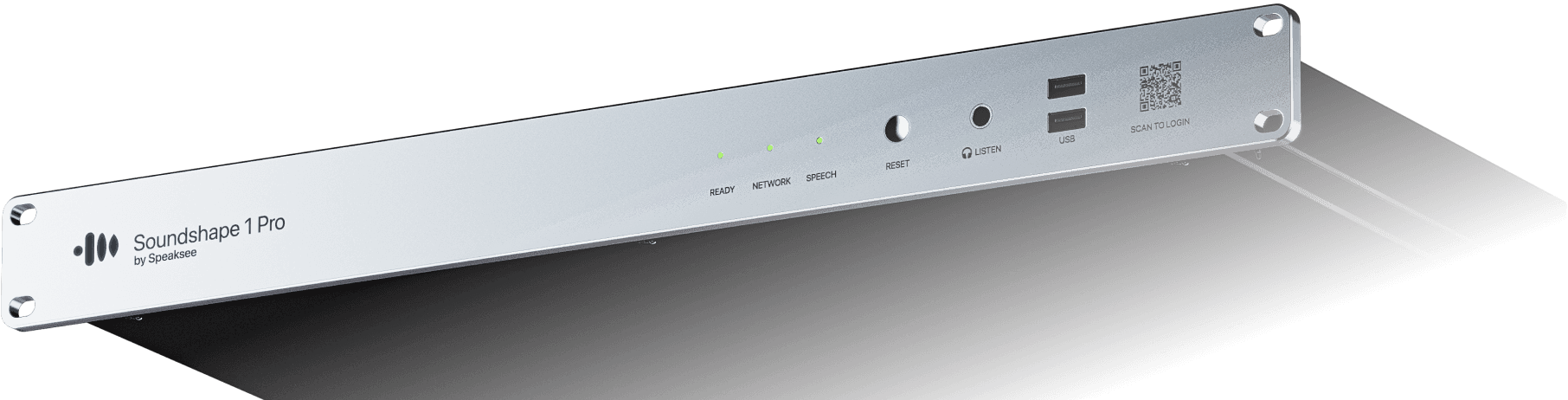
Soundshape provides AI-powered live captions and live translation in 100+ languages.
It is designed to fit into existing AV workflows. Captions and translations can be shown on event screens, smartphones, tablets, laptops and livestreams.
This gives event teams flexibility.
For one event, captions may be shown on the main screen. For another, attendees may prefer to follow a translation privately on their own device. A hybrid event may require both onsite and online access.
The setup should follow the needs of the event, not the other way around.
See how live captions and translation can fit into your event production.
Request a demo
Tell attendees what is available
Planning the solution is only part of the process.
Attendees also need to know that captions or translations are available and how they can access them.
Include this information in pre-event communication, on the event platform and in the venue. Brief the registration team, hosts and moderators so that they can point attendees in the right direction.
The instructions do not need to be complicated.
They do need to be visible.
When accessibility options are clearly communicated, they feel like a planned part of the event rather than a special arrangement that someone has to request.
A higher standard for every audience
Freya Foster’s article focuses on the expectations of Gen Z. The wider lesson applies to every generation.
People listen, read, process and understand information differently. International audiences are also becoming a normal part of many conferences, corporate events and government meetings.
Designing around one assumed type of attendee is therefore increasingly limiting.
A more useful starting point is to accept that audiences are varied and provide more than one way to follow the content.
Because an event is not fully accessible simply because everyone can enter the room.
They also need to be able to understand what is happening inside it.
Experience the quality, speed and simplicity of Soundshape in a live event setup.
Request a demo
Further reading: This article responds to Freya Foster’s perspective in Accessibility by design: why Gen Z expects more from events, published by M&IT.